
Product Training at Scale: How AI Turns Product Knowledge Into Learner-Ready eLearning
Product training turns existing product knowledge, documentation, specs, and decks into a learning experience that teaches employees what to do with that information in their specific role. AI powered eLearning authoring tools can structure product documentation into courses with learning objectives, scenarios, and assessments in a fraction of the time manual development takes. The output still requires human review for accuracy, relevance, and whether assessments test real application rather than recall, since speed alone doesn't guarantee that training actually works.
Introduction
A product launches on Tuesday. By Friday, sales has a deck, support has written a macro, and the product team has already fielded a dozen questions nobody thought to document anywhere. All of that is product knowledge. None of it is product training, and the distance between the two is where most onboarding delays, slow sales ramp, and avoidable customer mistakes actually come from.
Most L&D teams don't lack material to build from. What they lack is the time to convert that material into something a learner can practice with before the next release makes it outdated. That's the real problem here: not content creation, but content transformation, fast enough to keep pace with a product that never stops changing.
Product Documentation Was Never Designed to Teach
A specification sheet and a training module solve different problems, even when they describe the exact same feature.
Product knowledge training tells someone what exists: features, limits, pricing tiers, technical specifications. Product training asks a different question entirely: what should this person be able to do once they know it. A support rep who has read the documentation for a new integration hasn't necessarily learned how to walk a frustrated customer through it. Those are two different skills built on the same underlying facts.
Organizations that mistake comprehensive documentation for training-readiness usually discover the gap the expensive way, in a customer call, a missed sale, or a compliance question nobody on the floor can answer correctly.
The Real Bottleneck Isn't Product Knowledge, It's Instructional Transformation
Subject matter experts already hold the knowledge. What's missing is the structure that turns it into something a learner can absorb, practice, and apply.
Stanford's own guidance on course design puts this plainly: strong learning outcomes are built around what a learner will be able to do, not around a list of topics an instructor intends to cover. The University of Michigan's Center for Research on Learning and Teaching frames it almost identically, asking course designers to define what a learner should know, be able to do, or value before deciding on content or delivery.
That distinction, from what exists to what a learner can do with it, is exactly the layer most product content skips. A deck built for a product review meeting was never designed with a learning objective in mind, and repurposing it as training without adding that layer just relocates the documentation; it doesn't turn it into product training.
Product Training Is Becoming a Content-Lifecycle Problem
Product information doesn't sit still long enough for a slow, manual training process to keep pace with it, and the cost of that gap is measurable.
Gartner's 2026 research on B2B buying found that 69% of buyers report a meaningful inconsistency between what they researched independently and what a sales rep actually told them. That gap doesn't originate with dishonest reps. It originates with product training and public-facing content drifting apart as the product itself keeps changing, faster than most organizations refresh their internal materials.
Add multiple learner groups into the mix: sales needs positioning and objection handling, support needs troubleshooting depth, new hires need foundational product education, and a single static course stops being enough long before the product itself changes again.
What Good Product Training Actually Requires
Before AI enters the picture at all, it's worth being clear on what product training has to deliver regardless of how it gets built. Scaling it doesn't mean stripping out instructional design; it means protecting these elements while making production faster:
- A clear, measurable learning objective, not a topic list
- Role-specific depth, since sales, support, and new hires rarely need the same product education
- Realistic scenarios that turn a feature into a decision a learner has to make
- Assessment that tests application, not whether someone can repeat a sentence from the source document
CDC's quality training standards make the same point from a public health training context: content, activities, and assessment all need to trace back to a defined objective, or the course risks becoming a reformatted document rather than actual employee training.
How AI Changes the Product Training Workflow
Once that bar is set, the question becomes how to hit it at the pace a product actually changes. The shift isn't that AI writes better training copy it's that existing content becomes the starting point instead of a reference document nobody has time to convert.
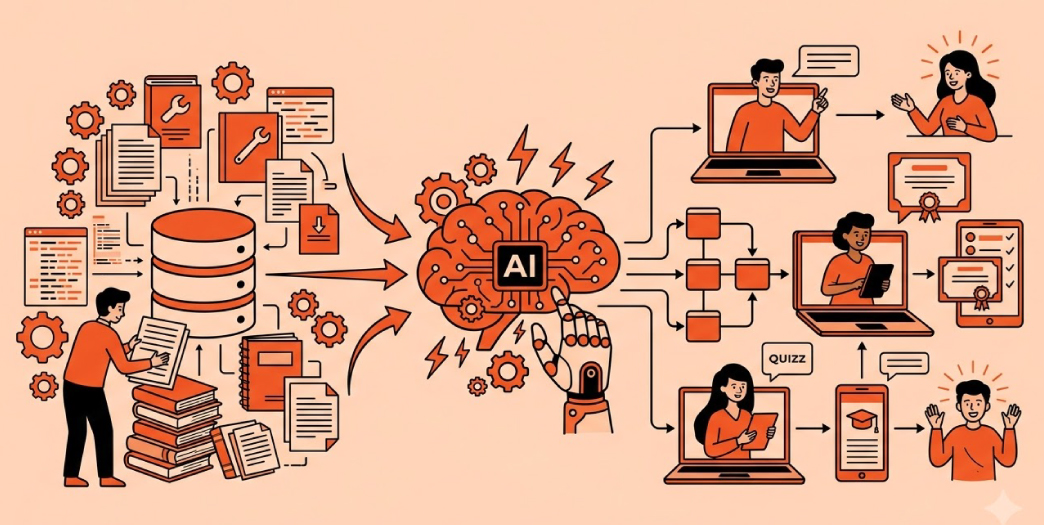
An AI powered eLearning authoring tool can read a product manual, a set of release notes, or a slide deck and propose a course structure, draft narration, and generate first-pass knowledge checks from it. That collapses the distance between having product knowledge and having a deployable, structured course, without asking an instructional designer to manually transcribe every slide into a script:
- Structuring large volumes of product information into modules
- Converting decks and documents into eLearning courses instead of static reference material
- Drafting knowledge checks and scenarios tied to the source content
- Producing multimedia and narration at a pace manual development can't match
- Updating existing courses when the underlying product content changes
What an AI Authoring Platform Needs to Get Right
Faster course creation doesn't automatically mean better learning, and treating the two as the same problem is how organizations end up with polished, generic training nobody retains. A course generated in an afternoon can still fail every test a good course has to pass, so an AI authoring platform earns its place in the workflow only if it holds itself to the same bar as a human-built course, not a lower one:
- Tie every module to a real objective. Structuring content faster only matters if the output still targets what a learner needs to be able to do, not just what the source document says.
- Generate role-specific variants from one source. A sales rep and a support rep pulling from the same release notes need different depth, and the platform has to produce both without two separate authoring passes.
- Test application, not recall. Assessments generated from source text are the easiest place for a platform to default to quoting the document back as a question instead of testing whether a learner can use it.
- Build review into the workflow, not bolt it on after. CDC's own quality standards tie this together directly: objectives, content, activities, and assessment all have to align, and that alignment is a judgment call, not an output a model can fully certify on its own.
- Regenerate quickly when the source changes. A course that isn't built to update fast becomes a liability the moment the product it describes moves on without it.
BrinX Puts That Checklist Into Practice
This is the checklist BrinX is built around, rather than a set of principles it pays lip service to after the fact. BrinX takes existing product and process documentation, presentations, and specs, and structures them into interactive, multimedia eLearning courses complete with objectives, role-specific assessments, narration, and visuals, with instructional design review built into the workflow before anything reaches a learner. For organizations converting product knowledge into training across multiple roles and frequent releases, that means starting from what already exists rather than rebuilding a course from a blank page every time the product changes. Product and process knowledge sits alongside onboarding, compliance, and professional development as one of the specific training needs the workflow is built to handle.
Conclusion and Key Takeaways
Organizations don't have a product knowledge shortage. They have a product training conversion problem, and closing it requires both faster transformation and the instructional judgment that makes a course actually teach something.
- Product knowledge explains what exists; product training teaches someone what to do with it.
- Effective product training starts with a learning objective, not a content inventory.
- An AI authoring platform only earns its place if it holds to that same bar role relevance, application-based assessment, and built-in review.
- BrinX applies that checklist directly to product content already sitting inside an organization.
If your product teams already have the content but your training function doesn't have the time to convert every manual, deck, and spec into a course, BrinX can close that gap. Book a demo and see what your next product training course could look like, built from the content you already have.
FAQs
What is product training?
Product training teaches employees how to understand, use, explain, or support a product in their specific role. It combines product knowledge with learning objectives, practice, and assessment, rather than simply presenting features and specifications.
What is the difference between product knowledge and product training?
Product knowledge covers what a product does, its features, specs, and benefits. Product training goes further, teaching an employee what to do with that knowledge in a real workplace situation, like a sales conversation or a support call.
How can AI improve product training?
An AI powered eLearning authoring tool can convert existing product documentation, decks, and manuals into structured courses with objectives, assessments, and multimedia, reducing the manual work of building training from scratch for every product update.
Can AI convert product documentation into eLearning courses?
Yes. AI can analyze product documentation and structure it into eLearning courses with modules, narration, and knowledge checks. The output still needs human review for accuracy, relevance, and whether assessments genuinely test application.
How can organizations scale product onboarding with AI?
AI reduces the repetitive work of rebuilding product onboarding for every new hire cohort or product update, repurposing existing content into structured courses while a reviewer confirms accuracy and role relevance before publishing.
Turn your content into a course
BrinX.ai converts your SOPs, policies, and training documents into multimedia-rich eLearning modules, fast.
Build your first course free